
Game Rules
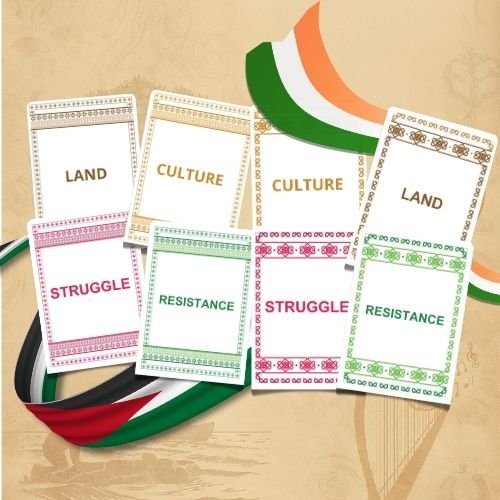
72 Core Cards
* 18 Struggle Cards
* 12 Land Cards
* 18 Resistance Cards
* 12 Culture Cards
* 12 Solidarity Cards
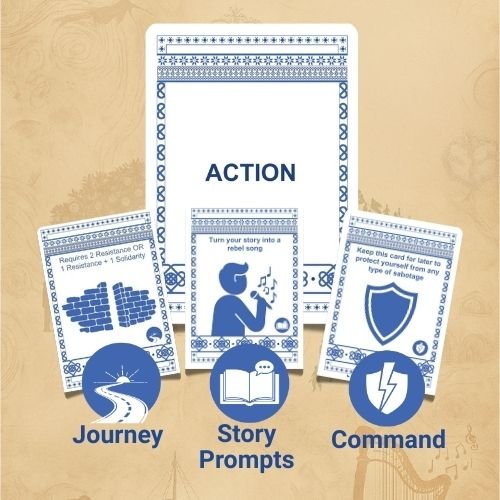
27 Action Cards
* 12 Story prompt cards
* 5 journey cards
* 10 command cards
Before You Play:
- Separate the decks by theme using the colored backs or icons (Struggle, Resistance, Culture, Land/Nature, Solidarity, and Extra Cards).
- Choose your game mode from the list below.
- Shuffle and deal as described — then let the stories unfold.
Tip for New Players:
If you’re playing Roots & Resistance for the first time:
- Start with Memory of Struggle (it will familiarise you with the cards).
- Move on to Tales of Resistance to get creative.
- Then try the deeper journeys (Exile & Return or Resistance vs Oppression) once everyone knows the cards.
4 Modes. 4 Games
Tales of Resistance
A storytelling game of memory, imagination, and protest.
This game reflects the strong storytelling traditions in both cultures and how memory survives through spoken stories.
Players: 3–8
Time: 30–45 minutes
Goal: Build the most compelling story of struggle and resistance using cards.
Setup
- Shuffle the Core Cards and deal 5 cards to each player.
- Shuffle the Story Prompt Cards and place them face-down in a pile.
How to Play
- Draw a Prompt
On your turn, draw 1 Story Prompt Card and read it aloud. - Tell a Story
Play 1–3 Core Cards from your hand.
Use them to tell a short story that follows the prompt. You have one minute using the sand timer - Replace Cards
Put the cards you used under the Core Card deck.
Draw the same number of cards so you always have 5. - Vote
After everyone has taken a turn:- Each player votes for their top 3 storytellers of the round
(1st = most points, 3rd = fewer points).
- Each player votes for their top 3 storytellers of the round
- Record Points
Keep track of scores each round.
Optional Twists
- You may add 1 card to another player’s story to extend or twist it.
If the group likes it, you earn bonus points. - If you use a direct Ireland ↔ Palestine pair (example: Ceilí ↔ Dabke), earn bonus points.
Winning
After the agreed number of rounds, the player with the highest total points wins.
Resistance vs Oppression
Defeat Oppression with your cards
This game mirrors how communities argue, resist, persuade, and survive under oppression.
Players: 3 – 6
Time: 40–50 minutes
Goal: The Hope and Culture Cards must overcome the oppression (Struggle)
Setup
- Shuffle the Struggle deck and place it face-down in the center.
- Each player draws:
- 3 Resistance cards
- 2 Solidarity cards
- 2 Culture cards
- Choose one player as the Judge for Round 1.
How to Play
- The Judge flips 1 Struggle card.
- All other players choose 1 card from their hand and place it face-down.
- Cards are revealed one by one.
Each player has 30–60 seconds to explain how their card defeats the Struggle, you can use the sand timer. - The Judge chooses the best explanation.
- The winner keeps the Struggle card as 1 point.
- All players take their cards back into their hands.
- The Judge role moves clockwise.
Optional Twist
If you win a round, you may keep that Struggle card as a Resistance card for future rounds. You can use that once.
Winning
After the chosen number of rounds, the player with the most Struggle cards wins.
Exile & Return
A cooperative/competitive journey to bring the exiled home.
This game reflects journeys of exile, resistance, and collective return.
Players: 2–6
Time: 30–45 minutes
Goal: Make a path from exile to homeland
What this game is
Each player builds a physical path of cards in front of them, moving step by step toward “home” by overcoming struggles.
Setup
- Struggle Deck
Shuffle all Struggle cards and place them face-down in the center.
This pile represents the Homeland. - Action Deck
Remove the Story Prompt cards and shuffle all the journey and command cards and place them face-down beside the Struggle deck. - Player Hands
Each player draws:- 3 Resistance cards
- 2 Land cards
- 2 Culture cards
- 2 Solidarity cards
- Keep these in your hand — this is your journey pack.
How to Play
- Reveal the Challenge
Flip:- 1 Struggle card (the problem)
- 1 Action card (how you must respond)
- Play a Card
Choose a card from your hand that fits the Action card’s instruction.
Explain briefly how it overcomes the Struggle. - Group Vote
- If the group agrees → place the card in front of you as one step forward.
Put the Struggle card under it. - If rejected → keep the card in your hand and do not move.
- If the group agrees → place the card in front of you as one step forward.
- Movement
- Success = move forward 1 card.
- Failure = no movement (or move back 1 card if already on the path).
Optional: Helping Each Other (Solidarity)
You may play a Solidarity card to help another player.
- If accepted → both players move forward 1 step.
- If rejected → both lose their turn.
Unhealed Pile
Failed Struggle cards go into a face-up Unhealed Pile.
Once per round, players may work together to heal one:
- At least 2 players each play a card and explain together.
- If approved → everyone involved moves forward 1 step.
Winning
The first player to build a 5-card path reaching the Homeland wins.
Memory of Struggle
A matching memory game of history and solidarity.
This game is about recognizing shared struggles, not memorizing facts. You win by building bridges between histories.
Players: 2–6
Time: 30-40 minutes
Goal: Be the first player to collect 5 accepted pairs by meaningfully connecting Irish and Palestinian cards.
What this game is
You match one Irish card with one Palestinian card by explaining how they connect.
There are no “right” answers — only whether the group agrees your connection makes sense.
Setup
- Choose Themes
As a group, choose 2 themes to guide the game (for example: Struggle and Resistance). - Prepare the Cards
Shuffle all chosen cards together.
Lay all cards face-up on the table so everyone can see them. - Choose a Starting Player
Any method works.
How to Play (On Your Turn)
- Pick Two Cards
Choose:- 1 Irish card
- 1 Palestinian card
- Explain the Connection
In a few sentences, explain how the two cards are connected.
The connection can be:- Historical
- Cultural
- Emotional
- Political
- Symbolic
- Example:
Great Famine (Ireland) ↔ Gaza Famine (Palestine)
“Both show how famine can be caused by political decisions, not just lack of food.” - Group Vote
All other players vote Yes or No.- If most say Yes → you win the pair and place it in front of you.
- If most say No → both cards stay on the table, and your turn ends.
- Next Player
Turns move clockwise.
Optional Rule: Collective Reframe
Once per game, if your connection is rejected:
- Ask one other player to help you explain it again.
- The group votes again.
- If accepted → you win the pair.
- If rejected → the cards stay on the table.
Winning
The first player to collect 5 approved pairs wins.
If the game feels stuck, the group may agree to:
- Add another theme, or
- Lower the win goal to 4 pairs.